

Thursday, August 14, 2025
Having left the east coast on May 14, 1804, Lewis and Clark glided into the northern side of the mouth of the Columbia River in dugout canoes in early November 1805. With starved looks, tattered clothes rotting on their bodies, and disheveled hair, they neither had the energy nor wherewithal to moor. Clark named the spot Dismal Nitch.

A group of local Indians arrived in elegantly carved and painted canoes, communicating with a few words of English they had learned from fur traders.
The captains Lewis and Clark had intended to meet the last trading ship of the season on the Pacific to obtain badly needed supplies and send back journals and specimens of plants and animals to President Jefferson. But a severe winter storm prevented this. This is “the most disagreeable time I have ever experienced,” Clark wrote.
Finally on November 15 the weather calmed, and they were able to view the Pacific Ocean from the cliffs above the pounding surf. They had arrived at the western end of their voyage – Cape Disappointment, named some 17 years earlier when another captain had failed to cross the shallow sandbank in search of an entrance to the Columbia River.
At the end of their westward journey Clark wrote, “O! the joy!”
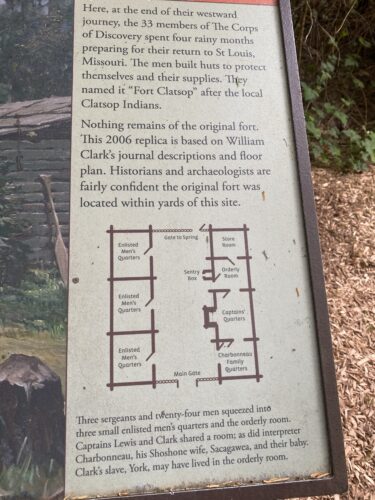
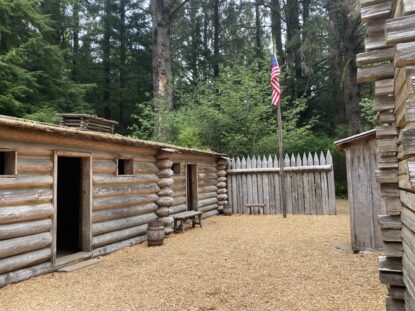
They camped for a week, but no food was to be found. The Indians informed them that if they relocated, they would find plenty of elk to hunt on the southern side of the river. They moved their camp and in less than 20 days built a seven-room log cabin, Fort Clatsop, where they spent the winter, eating elk for breakfast, lunch, and dinner, supplementing it with whale blubber, roots, fish, duck and beaver. They made salt from the waters of the Pacific Ocean to season their food, and fashioned clothes and moccasins from durable elk leather.
Using the slow-burning method, Indians taught them, they built six dugout canoes from ponderosa pine and on March 23, 1806, they departed eastward for home.
We visited Dismal Nitch and the cliffs of Cape Disappointment where a lighthouse is now located. I imagined seeing the land, the water, and the wilderness the way it was long before the country became the United States of America. Having experienced the pristine unspoiled open spaces, pride and tenderness spread through my body that made me feel closer to the land of my adopted country.
The cause of my quest slowly began to reveal itself: an unease about dying in a country which had not felt like home yet.
Jenn Diamond
I can hardly imagine, Madhu, and I love how you followed your instincts to find the roots of the calling for this adventure. Thank you for sharing!
Madhu B. Wangu
You’re welcome Jenn!
On the surface it was the reading of two hefty volumes of Lewis and Clark journals. But when I dig deeper it feels I had been searching for my identity as an American. The readings followed by the journey turned out to be the “solid ground” on which I could firmly stand and ponder about who I was?