

Tuesday, August 26, 2025
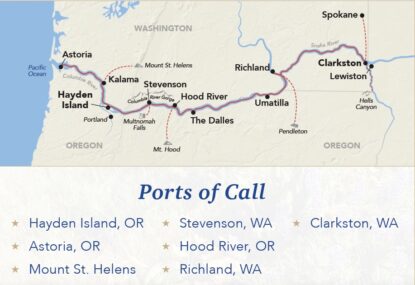
Lewis and Clark Exploration (The Corps of Discovery) shifted into settlements when fur traders and explorers moved westward within a few years after the captions and their crew returned home. Within 30 years (1830s-1840’s) began large scale settlements by ordinary families. That’s from where small American towns west of Mississippi trace their origin. Such historic towns, nestled in beautiful landscapes, reflect the persona of the American people – down to earth and friendly, proud of who they are and where they live.
Before taking the Corps of Discovery voyage, we had visited cosmopolitan cities in the United States – New York, Washington, Chicago, Boston, and Los Angeles – and capital cities of the world – Cape Town, Beijing, Tokyo, New Delhi, London, Paris, Rome and Lhasa. We had gazed at great monuments and sailed long rivers. But this time we walked through small American towns that we had not even heard about. Had they not been on the path of the Lewis and Clark voyage, they would never have been on our itinerary.
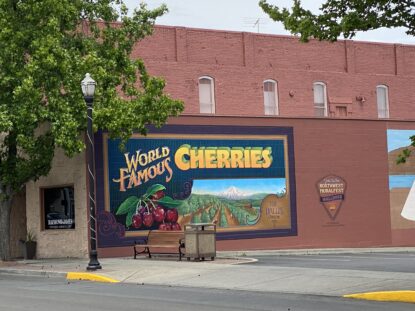
Dalles, Oregon, was the first such town. Settled in 1840, its population is 16,000. Lewis and Clark camped there for three days at Rockfort Campsite on October 25-27, 1805, on their way to the Pacific Ocean, and then on April 15-18, 1806, on their way back home. A rocky high point allowed them to make celestial observations, hunt for food, repair canoes, and negotiate to buy horses from local Indians. For me, Dalles became exemplary of small-town America, bringing me closer to the land that I have chosen to call home.
Three other small Oregon towns we visited were Cascade Locks, Umatilla, and Pendleton. “Columbia River is too powerful to navigate,” wrote Clark. In Umatilla, the captains purchased horses from the local Walla Walla tribe, then kept two canoes to ferry their supplies and proceeded upriver on foot. With “most excellent young horses” they feasted on beaver and otter and “experienced the best traveling on the western side of the Rockies.”
The town of Cascade Locks takes its name from eight locks that were built in the 1870s to improve navigation over the cascades of the Columbia River, which no doubt Lewis and Clark would have appreciated. These locks were eventually submerged and replaced by Bonneville Lock and Dam. The Bridge of the Gods spans the entire river.
The town of Pendleton used to be a booming mini city of saloons, card rooms, working girls, Chinese laundries, and opium dens. After a day’s hard work, men entertained themselves in brothels, gambling and drinking alcohol. Chinese laborers were brought here when railroads expanded westward. Regular businesses, such as candy stores and butchers, shared the secret underground world with bars and bordellos.

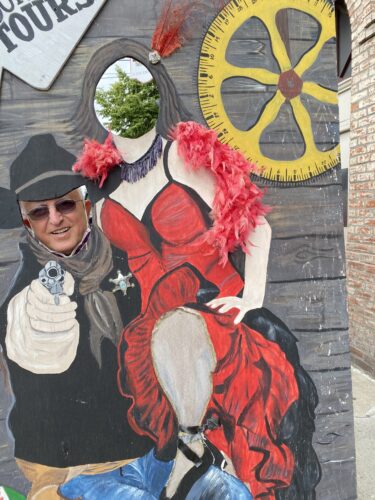
Some of the former bordellos are still active but the prohibition years are now staged with mannequins, furniture, and props, trying to recapture the spirit of the period. We toured the seedy underbelly of Pendleton that connects narrow passages hidden below the streets of what used to be a bustling market above. The normal and the nefarious coexisted.
Jennifer D. Diamond
LOVE the photos, Madhu! And I love how you hold the contradictions together beautifully; “The normal and the nefarious coexisted.”
Madhu B. Wangu
Thank you, Jenn!
That’s my husband, Manoj posing in the photos.